infragate pt2
I wrote a somewhat lengthy post about members of a group calling themselves “Effective Altruists” (who’ve inspired me to call myself a “calm and sexy philanthropist” btw) shooting blanks disguised as scientific rigor at virtually any and all criticism of datacenters or AI.
Beyond occasionally reading something I’ve been tagged in for my own amusement, I’ve spent my time regarding infrasound research on improving technical methods of data collection and hardware accessibility. It’s much more rewarding and I don’t have to talk to people nearly as much! Wanna hear about it? No? Too bad:
I’m attempting to make a sexy little Palm Pilot-looking device that has modules to measure air quality, audible noise pollution, and sonic pressure below 20Hz. The entire build should land me under $500, but the goal is to make an ESP32 version only for consistent infrasound measurement that can be purchased or assembled for under $100. After my traveling is done in May, I plan to go full time into this project and start creating a data map in regions that I’m not yet ready to disclose. Exciting! Anyway.
Someone linked me to something that caught my eye. It appears that a recent study suggesting higher cortisol levels related to infrasound exposure is being “debunked” by the same individuals “debunking” my videos. Much like last week when some of these folks harassed people suffering from illness potentially related to infrasound, they’ve moved on to harassing the authors of this newer research paper and contacting Frontiers In Behavioral Neuroscience demanding this incredibly detailed research be unpublished. Typing that sentence damages the little faith I have remaining in humanity, but I actually think there’s a lesson in humility to be learned here.
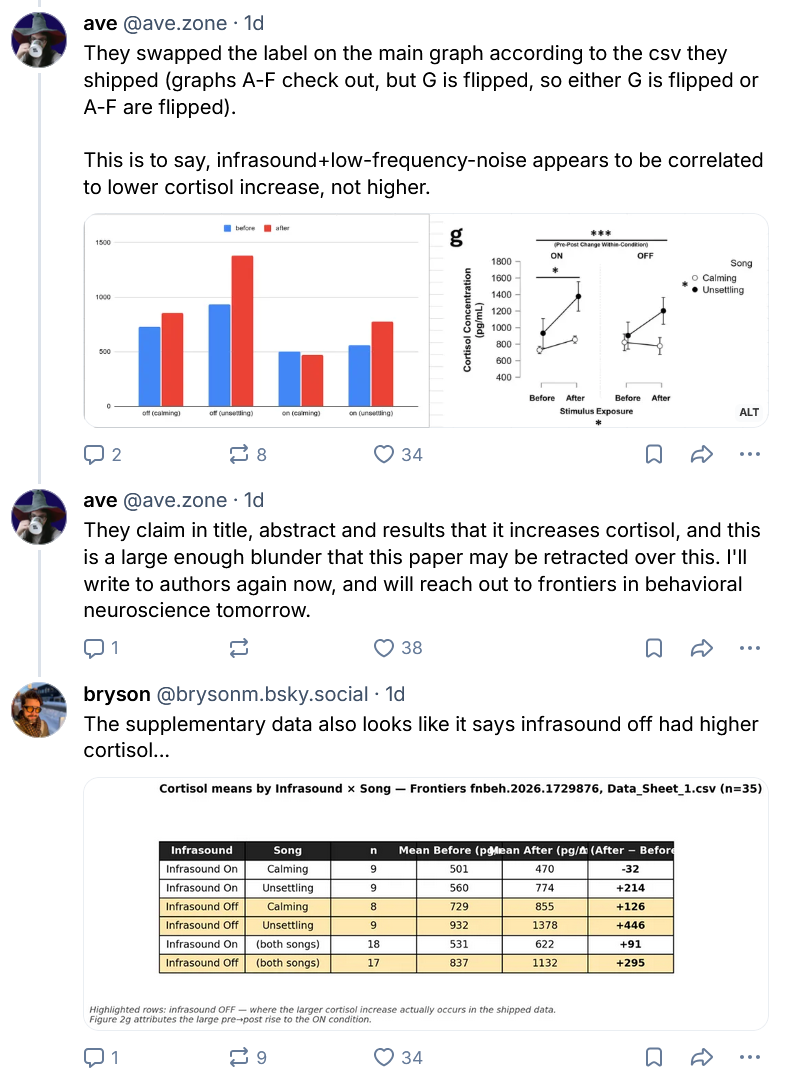
Feast your eyes on internet users analyzing raw data, and quite impressively, rather than assuming that their complete and total lack of experience in the interpretation of complex statistical modelling could be the problem, coming to the conclusion that all the researchers, reviewers, and publishers involved in the study missed an error where they accidentally or intentionally “flipped the data”, leading to the complete opposite conclusion. How clumsy!
About the study itself
While the paper was formally published a few days ago, the experiment itself took place in 2023. It’s safe to say that it has absolutely nothing to do with my video, datacenters, or anything other than scraping some money together to add additional data to be analyzed and used by the small (but growing) demographic of research scientists trying to understand the psychological and physiological effects of infrasound in humans.
It has a very small sample size and a glaring gender disparity among participants. I also have questioned the reliability of saliva-based cortisol measurements in controlled experiments, but this is not my area of expertise with my total of zero medical degrees hanging on my wall.
This isn’t my critique of the study. I believe the study is actually extremely well-organized and the analysis of the data is, if anything, overkill. Or maybe I’m just lazy.
But for the record, while nobody formally asked me to review it: this peer approves it.
But there’s something important to take away from this when paired with the wild world of special-interest-funded datacenter infrasound defense.
I’m not sure what Hollywood-science was expected, but at no point did anyone involved with this study expect it to be the final say in infrasound and human health. There is no good outcome or bad outcome. There is no “ah hah!” moment where it is deemed successful. That’s not how this works.
When you simply want to find out more about a phenomenon, data = good. Even if it’s not perfect. Even if it’s bad data. Unusable data is almost always unusable for a reason that is useful in the future. Even if the cortisol readings were clumsily flipped in some sort of wild Scooby Doo conspiracy to make infrasound look more dangerous than it is, the area of research is, at least abstractly, wiser than it was before the study.
into the weeds
If you just open up the CSV file in Excel and sum up the “Cortisol_Change" column, yes, it appears that infrasound made the subjects calmer. This isn’t mathematically wrong, it’s just ignoring 90% of the context. Even the most basic rudimentary studies aren’t binary observations based on steadfast inputs.
Andy Masley, the hub in which this strange controversy emerged, is a former physics teacher. Since I’ve blocked Andy for repeatedly insulting me, I’ll propose a point to him here.
If I were to rig up an incredibly sensitive torsion balance to verify the gravitational constant, attractions, and electrostatic changes of an apple. What could possibly go wrong with such a mundane and rudimentary experiment?
I’m assuming that Andy’s mind is lighting up with examples: Residue, air currents, humidity, temperature, calibration mistakes, and of course, even infrasound. It’s fucking chaos!
The reason for this discrepancy is large cortisol spikes among participants in the “off” condition (most notably, participants 5 and 20).
If the science-police on Bluesky actually read the paper from end-to-end instead of ramming it through an LLM, they’d notice that the study is not based on simple raw averages between the “on” and “off” groups, but favors ANOVAs that adequately account for other variables. The paper doesn’t hide this. In fact, it concludes that in their full unadjusted statistical model, there was no main intrinsic effect of infrasound on cortisol levels. They found the main effects for the passage of time, as cortisol generally went up before vs. after exposure. It was also stirred up a bit depending on the type of song played (calming vs. unsettling).
Then there’s emotional covariates (which sounds like either a really scary or desirable fungus).
The study found that infrasound had a statistically significant effect on raising cortisol only when they adjusted models to account for the volunteer’s self-reported negative emotions. When the model factored in feelings of being irritated, bad, afraid, or upset, infrasound emerged as having a significant main effect on cortisol changes. This suggests the physiological stress response was closely linked to the negative emotional states the infrasound induced.
Finally, while the study has “side-conditions”, the analysis accounts for “within-condition” data.
Rather than just comparing the "On" group to the "Off" group, they also looked at the "On" group in isolation.
They found that participants exposed to infrasound had cortisol levels significantly and reliably increased from their baseline pre-exposure levels.
But this isn’t a deep dive. It’s literally explained in the research paper.
show me the whitepapers!
This particular situation is bringing up traumatic memories from 2020, when 70% of Twitter and Facebook members became researchers in the field of epidemiology.
I had my opinions and conspiracy theories, but more than anything, I had made peace with the fact that I have absolutely no idea what the fuck I’m doing when analyzing statistics related to vaccine efficacy or MRNA sequencing charts. It’s fascinating and a little scary. As much as I hate appealing to authority, I had to concede that my ego was not going to keep me as safe as that Moderna juice hitting my flesh.
I’m not saying this in an attempt to gate keep science. I’ve struggled with imposter syndrome even while I was being paid to conduct research for reputable organizations. But the beauty of research is that you get to ask a question, pull a nice cozy blanket over your head to isolate you from the fervorous noise of debate, and creatively design ways to move one inch closer to answering that question. You don’t need a degree to do this. You don’t even need to know how to write a paper about it if you’re not interested in participating in peer-review or academic publishing. Sometimes you’ll make grave mistakes. Other times you’ll hit a bullseye. Either way, in a timeframe that eclipses your life, humanity will lumber one step forward. You get to be a tiny part of that. Better yet, if you’re like me, you get to enjoy it. But…
If you’re analyzing existing data as a researcher, you either use it or don’t.
If you’re analyzing data as a journalist, politician, or to find support for a particular argument, might it be best to just read the dozens of pages of methodology instead of ignoring it and summing up the numbers in a spreadsheet as if it were your taxes?